

Resort-themed plotted development can probably be called one of the more commonly used phrases in the Hyderabad residential real estate market over the last few years, referring to anything from basic plans with a pool all the way up to more ambitious projects based on an idea of a certain lifestyle. Like any other such catchphrase that becomes popular fast, it has been used in such a vague sense that consumers interested in finding out what it really stands for are entitled to ask how a truly resort-themed development differs from a regular layout that has just been marketed better and whether the price premium paid for the category is justified by what the consumer gets.
What “Resort-Themed” Actually Means in a Plotted Development Context
A traditional planned development provides land with well-defined boundaries, layout plans, internal streets, and utilities connected. The owner of the plot builds whatever they want as per the permitted parameters, and the neighbourhood that is created comes about because of the decisions made by hundreds of different individuals who are owners of their own plots over many years. The advantage of this approach is flexibility, while the disadvantage is that no common vision dictates how the neighbourhood will look.
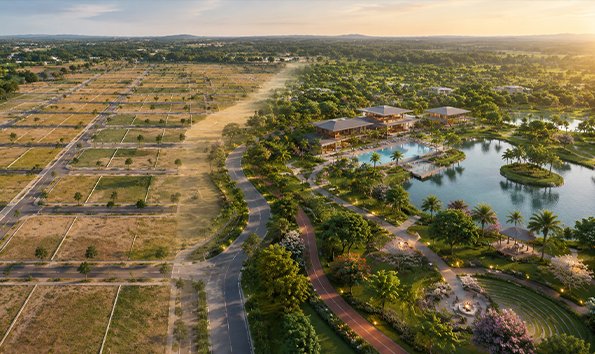
A resort-themed plotted development applies a fundamentally different organising principle. The developer curates not just the infrastructure but the entire experiential framework of the community, designing amenities, landscaping, common areas, and the overall atmosphere around a coherent resort-like character before any buyer takes possession of their individual plot. The result is a community with a specific, intentional quality of life proposition from day one rather than one that emerges gradually and unpredictably from individual construction decisions.
In practice, this typically means a substantial clubhouse, wellness facilities, recreational amenities including swimming pools, sports courts, and landscaped walking paths, nature-integrated design that treats the landscape as part of the product rather than the residual space between plots, and a maintenance and management structure that sustains the community’s character over time rather than allowing it to deteriorate without central oversight.
The Gated Community Advantage in Plotted Developments
Gated community advantage in plotted developments extends considerably beyond the obvious security benefit that controlled access provides. The gating of a resort-themed plotted community performs several functions simultaneously that open, non-gated layouts cannot replicate.
It creates a defined community of owners who share common infrastructure and maintenance obligations, producing the accountability and shared interest that sustains a development’s quality over years rather than allowing common areas to fall into neglect as individual owners focus entirely on their own plots. It provides a boundary that preserves the community’s character against the kind of incompatible development in adjacent areas that can erode an open layout’s quality regardless of how well-maintained the plots themselves might be. And it establishes the physical identity of the community as a destination in itself, an address that carries a specific character rather than simply being a collection of individually owned land parcels.
For buyers evaluating open plots in Hyderabad for sale, the gated community premium therefore represents not simply better security but a fundamentally different ownership proposition, one where the community environment is a managed, shared asset that exists independently of any individual plot owner’s construction decisions and that contributes to property value in ways that an open, individually constructed neighbourhood cannot deliver with the same reliability.
What a 30-Acre Resort-Themed Development Actually Contains
The scale of a resort-themed plotted development matters considerably for what it can deliver. A smaller development may have resort ambitions but insufficient land area to create the spatial quality, landscape depth, and amenity richness that genuine resort character requires. When a resort-themed community spans 30 acres with 312 plots across a range of sizes, it has sufficient scale to create genuinely different zones within the same development: active recreational areas, quieter garden spaces, a substantial clubhouse, water features, and the kind of landscaped walking routes that make the community genuinely pleasurable to move around rather than simply well-secured.
The 35,000 square foot clubhouse scale in a development of this size reflects an understanding of what 312 families with the lifestyle expectations of this buyer segment actually require from shared facilities. A clubhouse sized proportionately for genuine daily use by the community it serves, rather than one sized for a marketing render that nobody visits in practice, changes the lived experience of ownership in ways that plot specifications alone cannot account for.
Proximity to natural and recreational anchors near such a development, whether forests, reservoirs, hills, or established outdoor destinations, adds an outdoor dimension that a purely constructed amenity package cannot replicate. A resort-themed development adjacent to Ananthagiri Hills, Kotapally Reservoir, and Vikarabad Forest is drawing on a natural landscape that no developer can build from scratch, giving the community a relationship with genuinely wild natural surroundings that intensifies the resort character rather than simply approximating it through planted landscaping.
The Investment Case for Plotted Development
Plotted development investment in India has historically delivered strong long-term returns for buyers who understand the specific dynamics of land ownership compared to constructed property. The fundamental advantage is the absence of depreciation: a plot does not age in the way a building does, and the land value it represents grows with the corridor’s development momentum without the offsetting cost of structural aging that affects apartments and villas.
In a genuinely developing corridor, the combination of land scarcity, infrastructure investment, and institutional development activity around a plotted community produces appreciation dynamics that are relatively predictable for buyers with a sufficiently long-term outlook. DTCP approval, which provides the regulatory clarity and construction confidence that plot buyers require before committing significant capital, is a baseline that serious resort-themed developments will carry as a fundamental credential rather than a supplementary one.
The holding cost advantage of plotted ownership is also significant. A plot that is not yet constructed carries minimal carrying costs beyond basic land tax, which means buyers can hold through multiple market cycles without the maintenance, management, and vacancy cost burden that a constructed property imposes. This characteristic makes plots particularly well suited to the patient, long-horizon investment approach that land ownership in genuinely developing corridors rewards most generously.
How to Evaluate Whether the Premium Is Justified
The premium attached to a resort-themed plotted development over a comparable standard layout in the same area reflects the value of several things: the amenity infrastructure the developer has built, the managed community character it will sustain, the natural surroundings it has been positioned to leverage, and the developer’s track record of actually delivering what was committed to in the project marketing.
Evaluating whether that premium is justified requires a specific checklist. Is the clubhouse and amenity infrastructure actually complete or being built in a realistic timeline with committed delivery? Is the landscape and natural surroundings genuine rather than a handful of planted trees on a cleared site? Is the developer’s track record verifiable through completed projects that buyers can visit and evaluate against the quality that was promised? Is the regulatory approval status complete and documentable rather than in progress? And critically, does the developer’s management and maintenance structure suggest that the resort character will be sustained over the years of ownership rather than declining after the initial sales phase concludes?
Pros and cons of buying a villa plot in a resort-themed development tend to resolve clearly in favour of the investment for buyers who intend to hold for five or more years in a genuine infrastructure growth corridor, since the combination of land appreciation, managed community character, and lifestyle quality typically justifies the entry premium relative to a standard layout that offers none of the community infrastructure. For buyers seeking shorter-term liquidity, the premium may take time to fully materialise in resale pricing, which is worth factoring into timing expectations.
Why the Decision to Invest in Plotted Developments Rewards Specific Buyer Profiles
Invest in plotted developments is advice most appropriate for buyers who understand that land investment differs from apartment investment in its cash flow profile, liquidity characteristics, and appreciation timeline. The buyer who benefits most from a resort-themed plotted community is typically one who wants both a genuine lifestyle asset available for immediate enjoyment, as a weekend retreat, a future home site, or a family gathering destination, and a long-term land holding in a corridor with credible infrastructure momentum.
This dual-use profile, lifestyle today and investment over time, is precisely what the resort-themed format is designed to serve. A standard plot in an unamanaged layout may offer the same land appreciation story, but it does not deliver the immediate lifestyle value that justifies ownership beyond the purely financial case, which means it is held purely as a financial instrument rather than a lived experience. A resort-themed community adds the experiential dimension that makes ownership genuinely rewarding during the holding period rather than only at the eventual point of exit.
At Sri Sreenivasa Infra, Fortune Retreat in Mominpet represents our answer to what a resort-themed plotted development in Hyderabad’s western corridor should genuinely deliver. Spread across 30 acres with 312 DTCP-approved plots ranging from 222 to 400 square yards, positioned near Ananthagiri Hills, Kotapally Reservoir, and the Outer Ring Road, and anchored by a 35,000 square foot clubhouse, Fortune Retreat offers the combination of lifestyle richness, natural surroundings, and regulatory clarity that we believe justifies its premium over a standard plotted alternative in the same general area. With 22 years of delivery across 45 projects behind every commitment we make, we understand that the premium a buyer pays in a resort-themed community is an expression of trust, and we take that trust seriously enough to build the infrastructure that earns it.
Conclusion
A resort-themed plotted development is worth the premium when the development’s amenity infrastructure is genuinely built rather than promised, when the natural surroundings are real rather than approximated through landscaping, when the developer’s track record supports confidence in sustained delivery quality, and when the buyer’s holding horizon is long enough for land appreciation in a genuine growth corridor to fully express itself. For buyers evaluating open plots in Hyderabad for sale who are prepared to look beyond the standard layout category toward what plotted development investment in India can deliver at its best, the resort-themed format in the right location remains one of the more complete investment and lifestyle propositions available in 2026.