

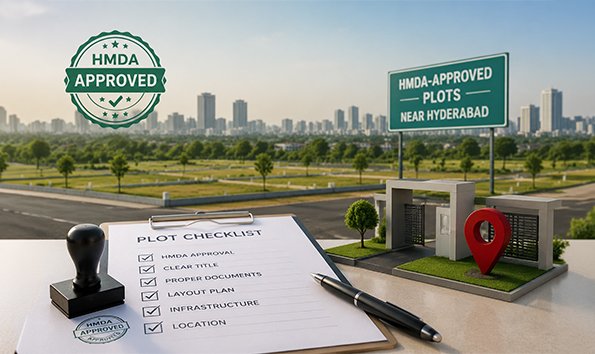
Plot purchases in Hyderabad’s peripheral corridors have a particular pattern of regret attached to them when they go wrong. The buyer was shown a piece of land that looked promising, the price seemed right, the developer assured them all approvals were in order, and only months or years later did the absence of proper authorisation become apparent, typically when construction plans were submitted and rejected, or when resale attempts revealed the title complications that had been quietly present from the beginning. HMDA-approved plots in Hyderabad exist precisely to prevent this pattern, but the approval label itself requires specific, active verification rather than passive acceptance of a developer’s claim to hold it. Understanding what to check before buying is the difference between a sound long-term land investment and an expensive lesson in due diligence.
What HMDA Approval Actually Means
The Hyderabad Metropolitan Development Authority governs land use planning and layout approvals across a significant portion of the metropolitan area surrounding Hyderabad. When a plotted development carries HMDA approval, it means the layout plan has been reviewed and sanctioned by this authority against applicable planning regulations, internal road widths have been verified to meet minimum standards, open space reservations have been allocated as required, and the overall layout conforms to the master plan for that zone.
This approval process provides several practical assurances that a buyer cannot obtain from a layout that lacks it. Construction permits can be obtained for an HMDA-approved plot without the additional scrutiny and potential rejection that unapproved layouts face. Bank financing, including home loans for subsequent construction, is considerably more straightforward on an HMDA-approved plot since lending institutions typically require regulatory approval as a standard credit criterion. And resale is meaningfully simpler because the approval status is documentable and transferable rather than requiring a fresh buyer to conduct the same laborious verification from scratch.
Advantages of buying HMDA-approved plots therefore extend across the full ownership lifecycle rather than being relevant only at the point of initial purchase. The approval is not simply a regulatory credential; it is a practical operational enabler that affects what a buyer can do with their land from the day they take possession through to eventual resale or transfer.
The Verification Steps That Cannot Be Skipped
Things to check before buying open plots in Hyderabad begin with a step that many buyers assume is unnecessary when a developer has provided an HMDA approval number: independent verification of that approval directly with HMDA rather than through documents provided by the sales team.
HMDA maintains records of approved layouts that can be verified against the survey numbers and layout reference numbers provided in the sale documentation. A buyer or their legal counsel should confirm that the specific plot being purchased falls within the approved layout boundary, since approvals are granted for layouts as a whole and individual plots within an irregularly amended or modified layout may not be covered by the original approval. The approval should also be current rather than lapsed, since approvals carry conditions and timelines that, if not met, can affect their continuing validity.
Title verification is a separate and equally essential exercise. An HMDA-approved layout can still have title complications arising from fragmented ownership histories, undisclosed liabilities, agricultural land conversion requirements that were not properly completed, or inheritance disputes among the original landowners. A title search conducted by a qualified property lawyer examining the encumbrance certificate going back a minimum of fifteen years is standard practice for any plot purchase of significance and should not be compressed or omitted regardless of the developer’s reputation or the urgency of any sales-driven deadline.
The encumbrance certificate, obtainable from the sub-registrar’s office for the relevant survey numbers, shows whether the land carries any registered mortgages, charges, or disputes that would affect the buyer’s ability to receive clean title. An EC that is clear of encumbrances for the period examined is a necessary but not sufficient condition for proceeding; it should be accompanied by confirmation that the land is not subject to any acquisition notifications, court orders, or government claims that may not appear in the EC but that a competent lawyer can identify through supplementary searches.
Is It Safe to Buy HMDA-Approved Plots?
Is it safe to buy HMDA-approved plots? is a question with a nuanced answer that depends on how the question is interpreted. HMDA approval significantly reduces the planning and development risk associated with a plot purchase by confirming that the layout has received regulatory sanction. It does not, however, provide any assurance about the developer’s financial position, the project’s delivery timeline, the accuracy of the title documentation, or the quality of internal infrastructure that may or may not be completed as promised.
Safety in a plot purchase is therefore a function of multiple parallel verifications rather than a single credential. HMDA approval addresses one critical dimension of risk but leaves several others entirely to the buyer’s own due diligence. A buyer who has verified HMDA approval, conducted a thorough title search, confirmed the developer’s track record through completed projects, checked RERA registration where applicable, and examined the physical infrastructure of the proposed development has done what can reasonably be done to protect their investment. A buyer who treats HMDA approval as a sufficient standalone credential has addressed one risk while leaving several others unexamined.
Checklist for Buying a Property in Hyderabad
A thorough checklist for buying a property in Hyderabad in the plotted development category covers several distinct areas that should be addressed sequentially rather than simultaneously, since conclusions from early stages inform how subsequent stages are approached.
Title and ownership documentation forms the starting point: the mother deed establishing the chain of ownership, all subsequent conveyance documents, the current registered title in the developer’s name, and confirmation that any required land use conversions from agricultural to residential classification have been properly obtained and registered.
Regulatory approvals come next: the HMDA layout approval with verified current status, any RERA registration where the project meets the registration threshold, NOCs from relevant authorities including groundwater, fire, and environment where applicable to the specific location and scale of development, and confirmation that the layout’s approved boundaries match the physical development on the ground.
Infrastructure and physical assessment includes verification that internal roads are constructed to approved widths, that utility connections including water, electricity, and drainage have been planned and are either in place or have committed timelines for completion, and that the common areas and amenities promised in marketing materials have a development timeline that is realistic relative to the project’s overall schedule.
Developer background completes the picture: a review of the developer’s completed projects to assess delivery quality and timeline adherence, any RERA complaints or regulatory actions on record, the financial standing that makes it reasonable to expect ongoing and completed delivery obligations to be met, and references from previous buyers willing to share their experience directly.
Best Locations to Buy Plots in Hyderabad in 2026
Best locations to buy plots in Hyderabad 2026 reflects a market in which several peripheral corridors have simultaneously reached the point where infrastructure investment and institutional development activity have begun to validate what early buyers assessed speculatively. The western and southwestern corridors, including Mokila, Mominpet, Shankarpally, and the broader zone anchored by the Regional Ring Road alignment, have attracted both residential developer activity and institutional development commitments that provide location credibility beyond individual developer claims.
The criteria that make a location compelling for plot investment in 2026 are consistent regardless of the specific micro-market being evaluated: proximity to a meaningful infrastructure catalyst whether ORR connectivity, proposed RRR access, or an institutional development like a technology park or township, availability of HMDA-approved layouts at entry prices that have not yet fully absorbed the anticipated infrastructure premium, social infrastructure either already present or credibly planned within a realistic timeline, and a regulatory environment that supports construction and eventual resale without the complications that agricultural land conversion, green zone restrictions, or water body proximity can create.
Mominpet specifically has attracted attention from buyers seeking both resort-lifestyle living and investment credentials, with its proximity to Ananthagiri Hills, Vikarabad Forest, and the Outer Ring Road combining the natural surroundings that lifestyle-oriented plot buyers value with the connectivity infrastructure that investment-oriented buyers require.
At Sri Sreenivasa Infra, Fortune Retreat in Mominpet represents our contribution to this corridor, 312 DTCP-approved plots across 30 acres ranging from 222 to 400 square yards, positioned near the Outer Ring Road and the natural landscapes of the Ananthagiri region, developed by a team with 22 years of verifiable delivery history across 45 projects. We hold documentation integrity and regulatory compliance as foundational obligations rather than optional credentials, and buyers evaluating Fortune Retreat are welcome to verify our approvals, our title documentation, and our track record through independent channels before making any commitment. That openness is itself part of what we mean when we say we build with diligence.
Conclusion
HMDA-approved plots in Hyderabad in the right corridors remain among the more compelling investment and lifestyle propositions in the city’s residential land market in 2026, but the approval label is the beginning of buyer due diligence rather than the end of it. Buyers who combine approval verification with thorough title examination, developer track record assessment, and honest evaluation of the location’s infrastructure trajectory are making genuinely informed decisions. Those who shortcut this process because a project looks credible on the surface are accepting risks that the regulatory framework was designed to reduce but cannot eliminate entirely on their behalf.